

By the end of 2026, getting to Morocco will be easier than finding your way out of a Fes alleyway. The government’s massive aviation push has added 52 new international flight routes, making it cheaper than ever to fly directly into regional hubs. But navigating the country’s ancient medinas, aggressive souk hustles, and cash-only logistics requires a solid game plan.
I’ve spent years getting lost in these labyrinthine streets, and this Morocco travel guide will keep you from making the rookie mistakes that turn a dream trip into an expensive headache. If you are planning to explore other regions of the continent, check out our comprehensive south africa travel guide to help plan your next journey.
Navigating the Medinas Without the Drama
Everyone told me Fes was beautiful, but they forgot to mention that Google Maps is completely useless inside the 9,000-alley maze of Fes el-Bali. The GPS signal bounces off the high mudbrick walls, leaving you stranded. Download Maps.me for offline navigation, or hire a licensed guide from the local tourist office. If you rely on your phone alone, you will get lost. It is a mathematical certainty.
While exploring Fes, you’ll inevitably end up at the Chouara Tannery. Operating since the 11th century, it is the oldest working medieval leather tannery in the city, where workers hand-dye hides in massive stone vats. Go between 8:00 AM and 11:00 AM when the colors are freshest and the heat hasn’t baked the pungent smell of ammonia into the air. Always accept the fresh mint sprig offered at the entrance to hold under your nose, and expect to tip the shop owner 10 to 20 MAD (about $1 to $2 USD) for terrace access if you don’t buy any leather goods.

The “Closed Road” Ruse
Around medina entrances in Fes and Marrakech, locals will insist the street ahead is closed for prayer or a festival. They’ll offer to show you an “open” route, which actually leads straight to a high-commission carpet shop. Politely say “La, Shukran” (No, thank you) and keep walking.
Beyond the Cities: Aït Benhaddou and the Sahara
If you head south toward the desert, you’ll hit the Ksar of Aït Benhaddou in Ouarzazate. This UNESCO-listed 17th-century earthen clay fortress has starred in everything from Gladiator to Game of Thrones. Most tourists arrive on day-trip buses at noon, bake in the 100°F heat, and leave. Skip the rush by staying overnight inside the ksar at a place like Kasbah Tebi, then watch the sunrise over the dry riverbed in absolute silence.

To avoid scams here, use the main bridge entrance to access the ksar for free. Locals hanging around the side paths will claim those routes are “private” and demand a fee. They aren’t, and you shouldn’t pay them a single dirham.
Packing for a Sahara Desert Excursion — step by step
Leave your main luggage in Marrakech or the support vehicle; you only want a light pack for the camel trek to camp.
Desert temperatures drop fast, plunging from 100°F (38°C) during the day to a chilly 40°F (4°C) at night.
Buy a long cotton scarf to wrap around your head and face to protect yourself from windblown sand.
What to Eat (and Where to Find It)
Marrakech’s Jemaa el-Fnaa is the beating heart of the city. At night, it transforms into an open-air theater of musicians, storytellers, and food stalls. To watch the chaos unfold without getting swept up in it, grab a mint tea on the rooftop terrace of Café de France just before sunset. When hunger strikes, skip the aggressive touts at the main square stalls and head straight to Mechoui Alley.

In Mechoui Alley, look for Chez Lamine Hadj Mustapha. This is where you try slow-steamed sheep’s head served with nothing but cumin and salt. If that’s too adventurous, order Tanjia Marrakchia instead. It’s a rich beef or lamb stew slow-cooked inside a clay jug in the embers of a local hammam’s bathhouse furnace, costing around 50 to 80 MAD ($5 to $8 USD).
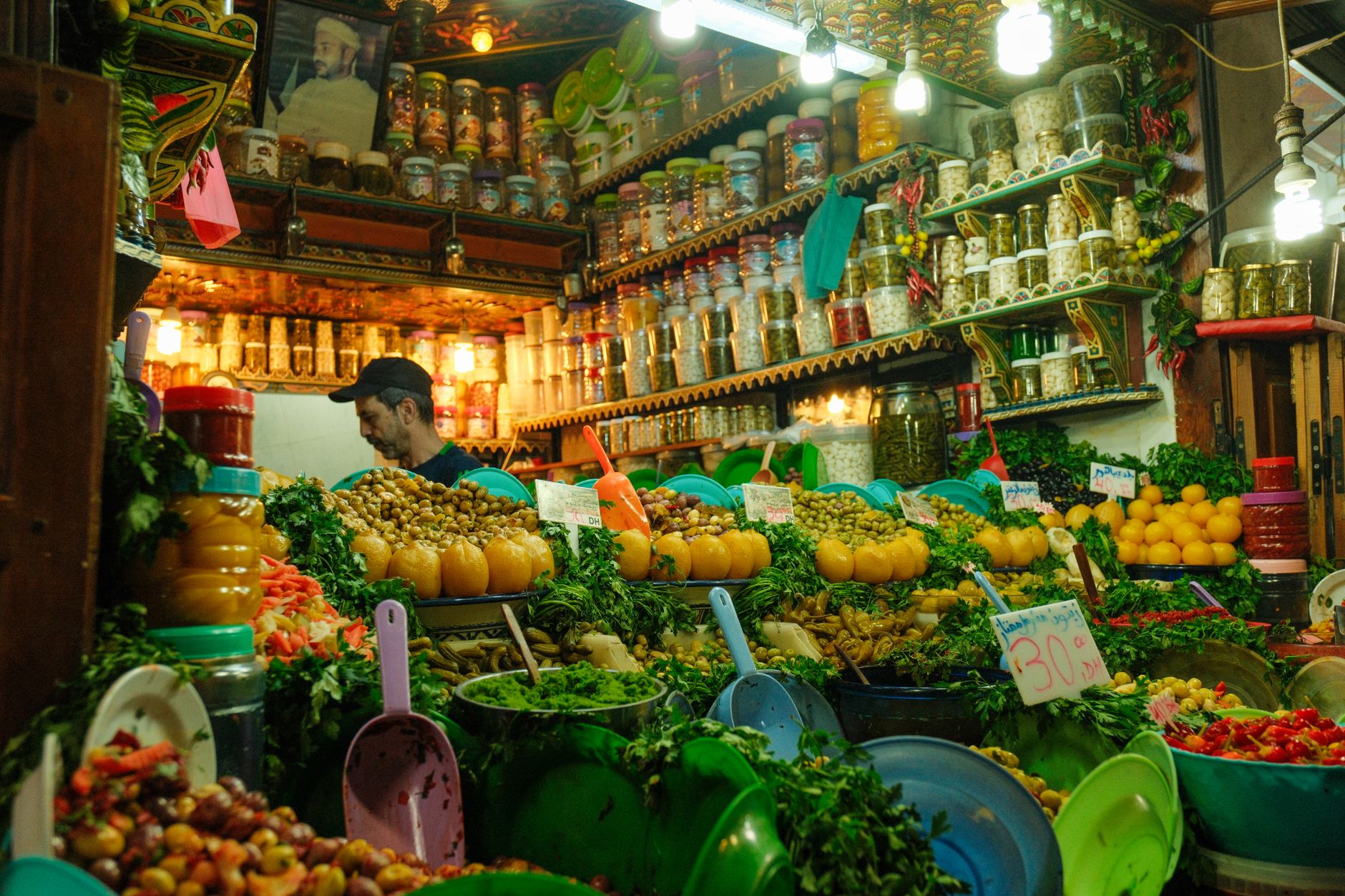
In Fes, the culinary prize goes to Chicken Bastilla. This imperial pie layers thin warka pastry with shredded chicken, almonds, eggs, and spices, all dusted with powdered sugar and cinnamon. It sounds like a bizarre combination, but the sweet-and-savory balance is surprisingly addictive. Expect to pay 50 to 80 MAD ($5 to $8 USD) in a traditional riad.

For a cheap, comforting meal, find a local street stall or head to food stand number 5 in Jemaa el-Fnaa for a bowl of Harira. This rich, tomato-based soup is packed with lentils, chickpeas, and cilantro, served alongside sweet dates and boiled eggs for just 10 to 20 MAD ($1 to $2 USD).
Crucial Safety and Logistics
Morocco is generally safe, but the street hustles in Marrakech can be exhausting. In Jemaa el-Fnaa, watch out for unsolicited henna artists who will grab your hand, apply a quick design, and aggressively demand 100 to 300 MAD. Keep your hands in your pockets when walking past them. Avoid “black henna” entirely, as it often contains toxic chemical dyes that cause severe skin burns.
Similarly, avoid the snake and monkey handlers. They will suddenly drape a snake around your neck or put a monkey on your shoulder, then demand 100 to 300 MAD for a photo. Do not make eye contact, do not stop to look, and step back immediately if they approach.
When it comes to money, cash is king. Souks, street stalls, and taxis only accept Moroccan Dirhams (MAD). Always carry small coins and 10 or 20 MAD notes for tipping (baksheesh), which is customary here—aim for 10% in restaurants and a few dirhams for hotel porters or restroom attendants.
Quick Facts — Morocco
Moroccan Dirham (MAD)
Arabic, Berber, French
GMT+1
Types C and E
March to May, September to November
Visa-free for most Western nations up to 90 days
Frequently Asked Questions
How do I get from Marrakech airport to the medina?
Take the Alsa Bus No. 19, which runs every 20 minutes directly from Marrakech Menara Airport (RAK) to the medina for 30 MAD ($3 USD) round trip. If you take a taxi, agree on a flat rate of 70 to 100 MAD ($7 to $10 USD) before getting in, as drivers frequently refuse to turn on the taximeter.
Is Google Maps reliable in Morocco?
It works fine in modern city areas, but it is notoriously inaccurate inside the ancient medinas of Fes and Marrakech. Download Maps.me and save offline maps before you go, as it maps the narrow alleys much more accurately.
Do I need cash or can I use credit cards in Morocco?
Morocco is highly cash-dominated. While high-end riads and modern restaurants accept credit cards, you will need Moroccan Dirhams (MAD) for souks, street food, taxis, and tips. Always carry small change.
Staying Connected
If you want to buy a local physical SIM card, you’ll need to present your passport for legal registration, whether you buy it at the airport or a city kiosk. Expect to pay between $5 and $20 (50 to 200 MAD) depending on the data package. While 4G and 5G coverage is excellent in major cities like Casablanca and Marrakech, it becomes patchy in the High Atlas Mountains and non-existent deep in the Sahara dunes. Keep in mind that internet-based calling (VoIP) on apps like WhatsApp or FaceTime can occasionally experience carrier-side throttling on mobile data, though they work fine on hotel WiFi.
To avoid the hassle of queuing at the airport, registering your passport with a local carrier, or dealing with throttled calls, grab a Morocco eSIM before you land. It connects automatically to the strongest local network as soon as you touch down, letting you load your offline maps and call an airport ride without wasting time in a mobile shop queue.